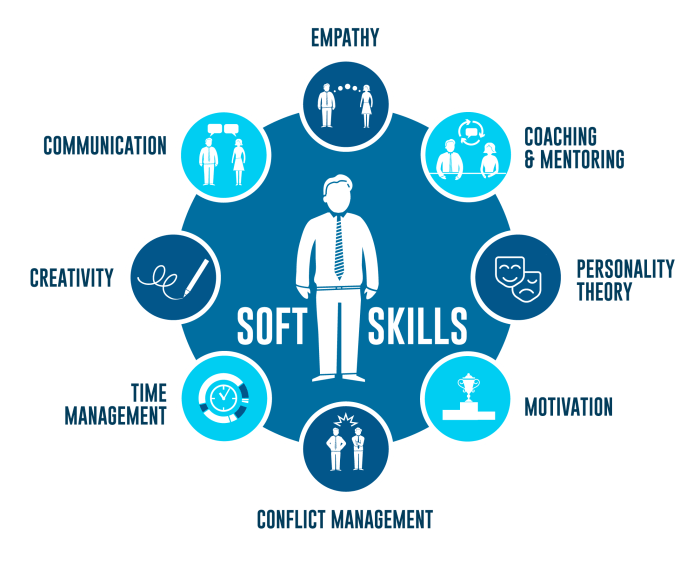
Soft Skills for Leadership Training sets the stage for this enthralling narrative, offering readers a glimpse into a story that is rich in detail with a casual formal language style and brimming with originality from the outset.
In this comprehensive guide, we will delve into the essential soft skills needed for effective leadership, the role of communication skills, emotional intelligence, decision-making skills, adaptability, and flexibility in leadership, as well as the significance of leadership training programs.
Soft Skills for Leadership Training
Effective leadership requires a combination of technical skills and soft skills. Soft skills are the personal attributes that enable individuals to interact effectively with others. In the context of leadership, the following soft skills are essential:
Essential Soft Skills for Leadership
- Communication: The ability to clearly convey information and ideas to team members.
- Emotional Intelligence: Understanding and managing emotions, both your own and others.
- Adaptability: Being able to adjust to changing circumstances and lead through uncertainty.
- Conflict Resolution: Resolving conflicts within the team in a fair and constructive manner.
- Empathy: Showing understanding and compassion towards team members.
Importance of Soft Skills in Leadership Roles
Soft skills play a crucial role in leadership as they help leaders build strong relationships with their team members, foster a positive work environment, and inspire trust and respect. Without these skills, even the most technically competent leaders may struggle to effectively lead a team.
Examples of Soft Skills Contributing to Successful Leadership
-
Effective communication
is key to ensuring that team members understand the goals and objectives of the organization.
-
Emotional intelligence
enables leaders to navigate challenging situations with empathy and understanding.
-
Adaptability
allows leaders to pivot and make decisions in response to unexpected changes.
Developing and Improving Soft Skills through Training Programs
Leaders can enhance their soft skills through dedicated training programs that focus on communication, emotional intelligence, conflict resolution, and other key areas. These programs often include workshops, coaching sessions, and real-world practice scenarios to help leaders refine their soft skills and become more effective in their roles.
Effective Communication Skills

Effective communication skills play a crucial role in leadership by fostering trust, clarity, and collaboration within a team. Leaders who can communicate effectively are better equipped to inspire and motivate their team members towards a common goal.
The Role of Communication Skills in Leadership
Effective communication skills are essential for leaders to convey their vision, goals, and expectations clearly to their team members. It helps in building strong relationships, resolving conflicts, and providing constructive feedback. Leaders who communicate effectively are more likely to earn the respect and trust of their team, leading to higher levels of engagement and productivity.
Strategies for Improving Communication Skills in a Leadership Context
Practice active listening
Leaders should listen attentively to their team members, show empathy, and ask clarifying questions to ensure understanding.
Develop emotional intelligence
Understanding emotions, both in oneself and others, can help leaders communicate more effectively and handle difficult situations with tact and sensitivity.
Provide clear and concise messages
Leaders should avoid jargon and communicate in a way that is easily understood by everyone on the team.
Seek feedback
Encouraging open and honest feedback from team members can help leaders identify areas for improvement in their communication style.
Written vs. Verbal Communication Skills
Written communication skills are important for documenting information, setting expectations, and providing feedback in a formal manner. Verbal communication, on the other hand, allows for instant feedback, tone modulation, and non-verbal cues that can enhance understanding and build rapport. Both written and verbal communication skills are vital for effective leadership, and a balance between the two is essential for clear and efficient communication.
The Importance of Active Listening in Effective Leadership Communication
Active listening involves fully concentrating on what the speaker is saying, understanding their message, and responding thoughtfully. Leaders who practice active listening demonstrate respect, empathy, and a willingness to understand different perspectives. This fosters trust, encourages open communication, and helps in building strong relationships within the team.
Emotional Intelligence in Leadership
Emotional intelligence is the ability to recognize, understand, and manage our own emotions while also being able to perceive, interpret, and respond to the emotions of others. In the context of leadership, emotional intelligence plays a crucial role in building strong relationships, making sound decisions, and fostering a positive work environment.
Significance of Emotional Intelligence in Leadership
Emotional intelligence can positively impact leadership outcomes in various ways. Leaders who possess high emotional intelligence are better equipped to handle stress, communicate effectively, and inspire their teams. By being aware of their own emotions and those of others, leaders can build trust, resolve conflicts, and motivate their team members to achieve common goals.
Tips for Developing Emotional Intelligence as a Leader
- Practice self-awareness: Reflect on your emotions and how they influence your behavior.
- Improve empathy: Put yourself in others’ shoes to better understand their perspectives.
- Enhance social skills: Develop strong communication and relationship-building abilities.
- Manage emotions effectively: Learn to regulate your emotions in different situations.
Using Emotional Intelligence to Manage Conflicts within Teams
Effective leaders use emotional intelligence to navigate conflicts within teams by staying calm, listening actively, and showing empathy towards all parties involved. By understanding the underlying emotions driving the conflict, leaders can address the root cause, facilitate open communication, and work towards a resolution that benefits everyone.
Decision-Making Skills for Leaders
Effective leadership requires strong decision-making skills to navigate challenges and opportunities successfully. Leaders must be able to make timely and informed decisions to steer their teams towards achieving organizational goals.
Different Decision-Making Models
- Rational Decision-Making Model: This model involves a systematic process of gathering information, analyzing options, and choosing the best course of action based on logic and reasoning.
- Intuitive Decision-Making Model: In this model, leaders rely on their instincts, past experiences, and emotions to make quick decisions, especially in high-pressure situations.
- Collaborative Decision-Making Model: Leaders involve team members in the decision-making process to gather diverse perspectives and ensure collective buy-in for the chosen course of action.
Examples of Successful Decision-Making in Leadership
Steve Jobs’ decision to introduce the iPod revolutionized the music industry and propelled Apple to new heights.
Indra Nooyi’s decision to focus on healthier products at PepsiCo led to increased market share and improved brand reputation.
Strategies for Improving Decision-Making Skills
- Seek feedback from peers and mentors to gain different viewpoints and insights.
- Practice scenario analysis to evaluate potential outcomes and risks before making a decision.
- Develop a decision-making framework that aligns with the organization’s values and goals.
Adaptability and Flexibility
Adaptability and flexibility are crucial skills for leaders to possess in today’s fast-paced and ever-changing business environment. Leaders who can adapt to new situations and remain flexible in their approach are better equipped to handle challenges and lead their teams effectively.
The Importance of Adaptability and Flexibility in Leadership Roles
Adaptability and flexibility allow leaders to respond quickly to changes in the market, industry, or organization. By being open to new ideas and willing to adjust their strategies, leaders can stay ahead of the curve and guide their teams through uncertainty.
- Adaptability enables leaders to embrace innovation and drive positive change within their organizations.
- Flexibility allows leaders to pivot and adjust their plans when faced with unexpected obstacles or setbacks.
- Leaders who are adaptable and flexible inspire confidence in their teams and foster a culture of resilience and creativity.
Examples of How Being Adaptable Can Help Leaders Navigate Change
- During a merger or acquisition, a leader who is adaptable can help integrate new teams and processes seamlessly.
- In times of crisis, a flexible leader can make quick decisions and adapt to rapidly changing circumstances to ensure the safety and well-being of their team.
- When faced with new technologies or market trends, an adaptable leader can pivot their strategies to capitalize on emerging opportunities.
Strategies for Cultivating Adaptability and Flexibility in Leadership Training Programs
- Encourage leaders to embrace uncertainty and view change as an opportunity for growth and learning.
- Provide scenarios and case studies that require leaders to think on their feet and adapt their strategies in real-time.
- Offer coaching and feedback to help leaders identify areas where they can improve their adaptability and flexibility skills.
How Adaptability Contributes to a Leader’s Ability to Inspire and Motivate Others
- Leaders who are adaptable and flexible can inspire confidence in their teams by demonstrating resilience and a willingness to try new approaches.
- By adapting to changing circumstances and remaining open to feedback, leaders can create a culture of continuous improvement and innovation.
- Adaptability allows leaders to tailor their communication style and approach to meet the unique needs of each team member, fostering stronger relationships and motivating team members to perform at their best.
LEADERSHIP TRAINING
Leadership training programs are designed to enhance the skills and qualities necessary for effective leadership within an organization. The purpose of these programs is to develop individuals who can inspire, motivate, and guide others towards achieving common goals. The goals of leadership training include improving communication, decision-making, emotional intelligence, adaptability, and other essential soft skills that are crucial for successful leadership.
Types of Leadership Training Approaches
- Workshops: These are interactive sessions where participants engage in activities and discussions to learn and practice leadership skills.
- Seminars: These are more formal gatherings where experts share knowledge and insights on leadership topics with a larger audience.
- Coaching: One-on-one coaching sessions provide personalized guidance and feedback to help individuals develop their leadership abilities.
Successful Leadership Training Initiatives
- Google’s “Leadership Development Program” focuses on empowering employees to become effective leaders through mentorship, training, and hands-on experience.
- General Electric’s “Crotonville Leadership Development Institute” offers a variety of leadership courses and workshops to cultivate leadership skills at all levels of the organization.
Benefits of Continuous Leadership Training
- Improved Performance: Individuals who undergo continuous leadership training are better equipped to handle challenges and drive results in their roles.
- Employee Engagement: Organizations that invest in leadership development show a commitment to their employees’ growth and development, leading to higher engagement and retention.
- Innovation: Leaders who receive ongoing training are more likely to think creatively, adapt to change, and drive innovation within their teams.
As we conclude our exploration of Soft Skills for Leadership Training, it becomes evident that these skills are not just desirable but crucial for the success of any leader. By honing these attributes, individuals can truly become impactful leaders who inspire and drive positive change within their organizations.
FAQ Corner
What are some examples of essential soft skills for effective leadership?
Some essential soft skills for effective leadership include communication, emotional intelligence, adaptability, and decision-making.
How can leaders improve their decision-making skills through training programs?
Leaders can improve their decision-making skills through training programs by learning different decision-making models and practicing making strategic choices.
Why is emotional intelligence important in leadership roles?
Emotional intelligence is crucial in leadership roles as it helps leaders understand and manage their emotions and those of their team members, leading to more effective communication and conflict resolution.