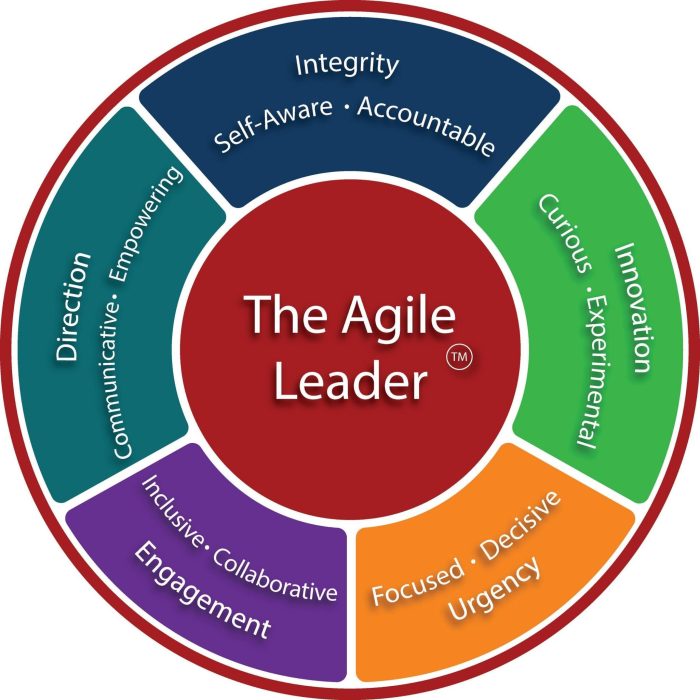
Embark on a journey through the realm of Agile Leadership Training, where innovative strategies and essential skills converge to shape the future of organizational leadership.
Explore the dynamic principles of Agile Leadership and discover how they revolutionize traditional leadership paradigms.
Overview of Agile Leadership Training

Agile Leadership Training is a specialized program designed to equip leaders with the skills and mindset needed to thrive in fast-paced and unpredictable business environments. In today’s rapidly changing world, where innovation and adaptability are key to success, Agile Leadership Training plays a crucial role in helping organizations stay competitive and responsive to evolving market demands.
Core Principles of Agile Leadership
- Embrace Change: Agile leaders understand the value of change and are willing to adapt their strategies quickly to seize new opportunities.
- Collaborative Decision-Making: Agile leadership emphasizes teamwork and collaboration, encouraging leaders to involve team members in decision-making processes.
- Iterative Approach: Agile leaders focus on incremental progress and continuous improvement, breaking down projects into smaller, manageable tasks.
- Feedback-Oriented: Agile leaders prioritize feedback from team members and stakeholders, using it to make informed decisions and drive performance improvements.
Benefits of Agile Leadership Training Programs
- Enhanced Adaptability: Agile Leadership Training equips leaders with the skills to navigate uncertainty and respond effectively to changing circumstances.
- Improved Team Collaboration: By promoting a culture of collaboration and open communication, Agile Leadership Training fosters stronger relationships within teams.
- Increased Innovation: Agile leaders are better equipped to drive innovation and creativity within their organizations, leading to a competitive edge in the market.
- Higher Employee Engagement: Agile leadership practices empower employees, resulting in increased motivation, productivity, and job satisfaction.
Key Components of Agile Leadership Training
Agile leadership training focuses on developing essential skills that enable leaders to effectively navigate the dynamic and fast-paced environment of Agile methodologies. Through training, Agile leaders cultivate a set of competencies that are crucial for success in leading teams and projects with agility and adaptability.
Essential Skills for Agile Leaders
- Effective Communication: Agile leaders must excel in clear and concise communication to ensure alignment within the team and with stakeholders.
- Collaboration and Team Empowerment: Encouraging collaboration and empowering team members to make decisions fosters a culture of trust and innovation.
- Problem-Solving and Decision-Making: Agile leaders need to be adept at solving problems quickly and making informed decisions under pressure.
- Change Management: Embracing change and guiding teams through transitions are critical skills for Agile leaders.
Role of Emotional Intelligence in Agile Leadership
Emotional intelligence plays a vital role in Agile leadership by enabling leaders to understand and manage their emotions, as well as empathize with team members. Through training, leaders can cultivate emotional intelligence skills such as self-awareness, self-regulation, social awareness, and relationship management. This leads to improved team dynamics, conflict resolution, and overall team performance.
Importance of Adaptability and Resilience
Adaptability and resilience are key components of Agile leadership practices as they allow leaders to respond effectively to changing circumstances and setbacks. Agile leaders must be flexible in their approach, willing to adapt to new information, and resilient in the face of challenges. Training helps leaders build the necessary skills to navigate uncertainty and lead with confidence in complex environments.
Strategies for Implementing Agile Leadership Training Programs
Implementing Agile Leadership Training programs requires a strategic approach to ensure successful integration into existing leadership development initiatives. Organizations need to create a culture that supports Agile leadership principles through targeted training efforts. Let’s explore effective strategies for implementing Agile Leadership Training programs.
Integrating Agile Leadership Training
- Identify key leadership roles that would benefit most from Agile training.
- Create a customized training plan that aligns with the organization’s goals and values.
- Offer continuous support and resources to leaders undergoing Agile training.
Creating a Supportive Culture
- Encourage open communication and collaboration among team members and leaders.
- Reward and recognize behaviors that demonstrate Agile leadership principles.
- Provide opportunities for leaders to practice Agile methodologies in real-world scenarios.
Examples of Successful Agile Leadership Training Programs
Company X implemented an Agile Leadership Training program that resulted in a 20% increase in team productivity and a 15% decrease in project timelines.
Organization Y saw a significant improvement in employee engagement and retention rates after introducing Agile leadership principles through training.
Assessing the Impact of Agile Leadership Training
Measuring the effectiveness of Agile Leadership Training programs is crucial in determining the return on investment and the overall impact on organizational performance. Several key metrics can be used to assess the success of these programs.
Measuring Effectiveness of Agile Leadership Training Programs
- Evaluation of Leadership Behavior Changes: Monitor and evaluate how leaders implement agile practices and principles in their day-to-day activities.
- Employee Engagement and Satisfaction: Measure the level of employee engagement and satisfaction post-training to see if there is a positive impact on team dynamics.
- Project Success Rates: Analyze project success rates before and after implementing Agile Leadership Training to see if there is an improvement in project outcomes.
- Time to Market: Assess if there is a decrease in time to market for products or services after Agile Leadership Training, indicating improved efficiency.
Challenges in Implementing Agile Leadership Training and Solutions
- Resistance to Change: Some organizations may face resistance from leaders or employees when transitioning to agile methodologies. To overcome this, provide proper training, support, and communication throughout the process.
- Lack of Alignment: Ensure that all levels of leadership are aligned with the agile principles and practices to avoid conflicting priorities and confusion among team members.
- Resource Constraints: Limited resources such as time, budget, or expertise can hinder the successful implementation of Agile Leadership Training. Address this by prioritizing key initiatives and providing adequate support.
Success Stories of Companies Benefiting from Agile Leadership Training
Company X implemented Agile Leadership Training across all levels of management and saw a 20% increase in project success rates within six months of the program.
Organization Y improved employee engagement by 30% after introducing Agile Leadership Training, leading to a more collaborative and innovative work environment.
In conclusion, Agile Leadership Training equips leaders with the tools to navigate today’s complex business landscape with agility and resilience, fostering a culture of continuous improvement and growth.
FAQ Section
What are the core principles of Agile Leadership?
Agile Leadership emphasizes adaptability, collaboration, and iterative improvement in decision-making processes.
How can organizations measure the effectiveness of Agile Leadership Training?
Organizations can assess the impact of training programs by tracking key performance indicators related to leadership development and team efficiency.
Why is emotional intelligence crucial in Agile Leadership?
Emotional intelligence enhances leaders’ ability to understand and connect with team members, fostering a positive work environment and improving team dynamics.